IB ESS SL Tutoring
One-to-one online preparation for the ESS Standard Level syllabus
IB ESS SL is a popular choice because it counts for both Group 3 and Group 4, and that is also the catch: the exam expects you to speak two languages at once, scientific and social. In 90-minute sessions we work on systems diagrams and environmental value systems, and help you land an Individual Investigation question you can actually measure.
Quick Answer
Data collection for the ESS SL Individual Investigation often happens outdoors, so the season matters – we suggest fixing the plan by the second term of IB 1 at the latest. A 10-lesson package is usually enough for exam preparation. Sessions are 90 minutes and fully online.
SL
Level
Fully Online
Format
90 min
Lesson length
€85 per 90 min one-to-one lesson
Not happy after your first lesson? Full refund.
See packages and lower per-lesson rates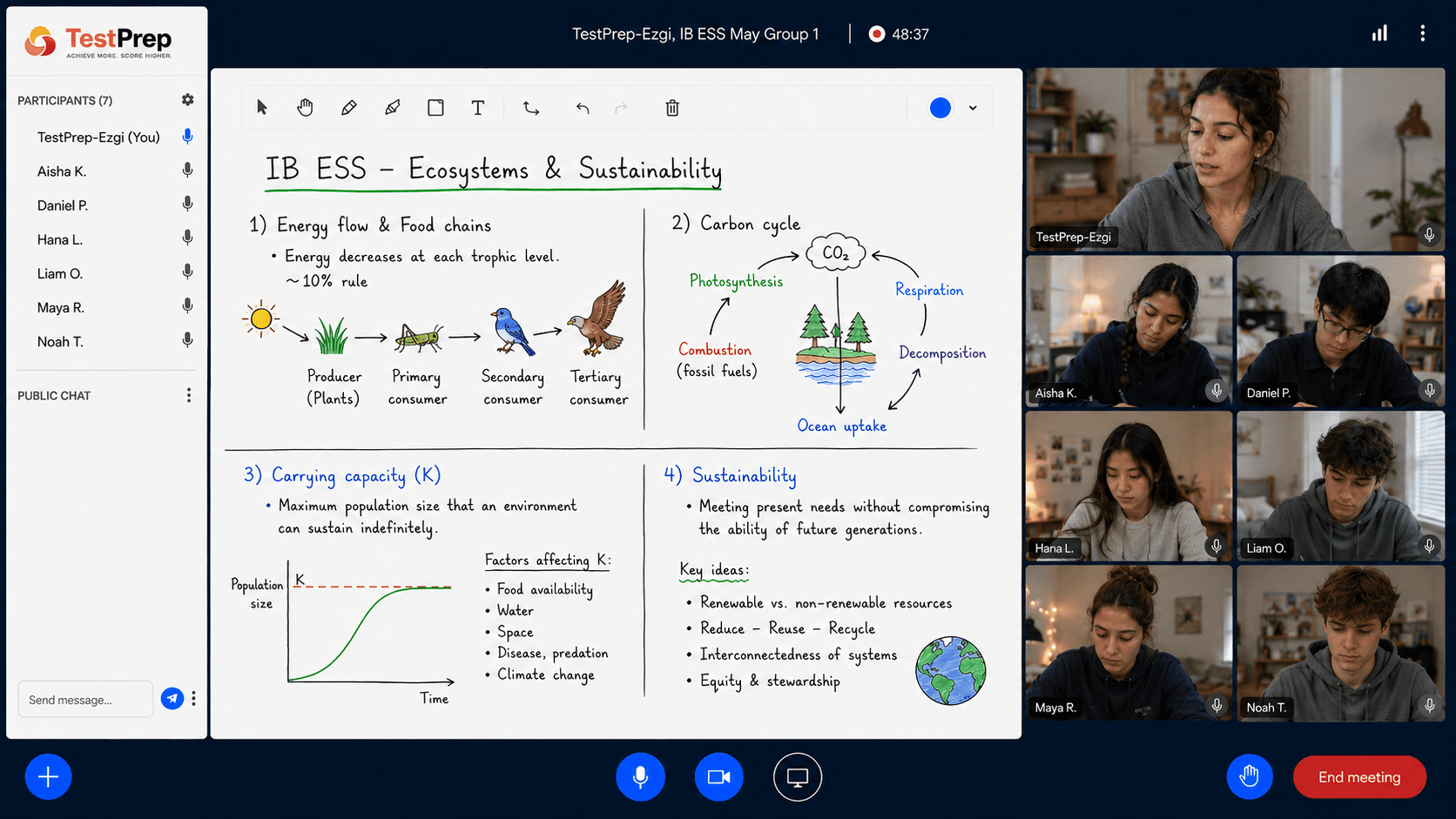
IB Specialists
Experienced Team
About IB ESS SL Tutoring
Our IB ESS tutoring programme fully covers the Environmental Systems and Societies syllabus, the interdisciplinary course of the IB Diploma Programme. We look at environmental issues from both scientific and social perspectives. IB ESS is the only IB subject that can satisfy both the Group 3 and Group 4 requirements on its own.
The new guide, in force from August 2024 and first examined in May 2026, is built on eight topics: Foundation, Ecology, Biodiversity and Conservation, Water, Land, Atmosphere and Climate Change, Natural Resources, and Human Populations and Urban Systems. Apart from Foundation the topics may be taught in any order, and each one is linked to current environmental issues.
What makes ESS unique is that it brings science and the social sciences together. We cover both the scientific basis of environmental issues and their social, economic and political dimensions, and our teachers show students how to combine the two.
Climate change is one of the key topics in the ESS syllabus. We cover the greenhouse effect, the mechanisms of global warming, climate models, their effects and mitigation strategies in detail. The Paris Agreement and international environmental policy are also covered.
The Internal Assessment (IA) makes up 25% of the IB ESS grade. We provide support during the IA: choosing a research question, data collection methods, analysis and evaluation writing.
Exam strategy gets particular attention, with separate preparation for Paper 1 (case study) and Paper 2 (short answer and essay), plus regular past-paper practice and mark scheme analysis.
Every programme is built around the student's interests and goals. ESS is a valuable course for students aiming for careers in environmental science, sustainability, policy or international relations.
IB assessment experience
Lessons are planned with teachers who have relevant subject experience and a strong command of the IB assessment criteria. Matching is done by subject, level, the student's current standing and teacher availability.
Syllabus Topics
Exam Papers
First exams 2026IB ESS SL exam structure and focus areas
| Paper | Duration | Weighting | Focus |
|---|---|---|---|
| Paper 1 | 1 hour | 25% | Case study, 1 hour |
| Paper 2 | 2 hours | 50% | Short answer and essay, 2 hours |
| IA | — | 25% | Individual Investigation |
Source: the assessment components and weightings on this page follow the IB ESS SL subject guide published by the International Baccalaureate Organization (First exams 2026). Your school's IB coordinator can access the current session documents. ibo.org
About grade boundaries: According to the grade boundary documents the International Baccalaureate Organization publishes for each exam session, the total percentage needed for a 7 varies by subject, level and session in a band of roughly 55–85%. Your school's IB coordinator can access the relevant May/November Grade descriptors and boundaries document. In our one-to-one lessons we review the student's realistic grade range together using past-session boundaries and mock results.
IA / Written-Task Support
Where do one-to-one lessons help with the Internal Assessment and written tasks?
A question you can actually measure
Research questions in this subject slip out of reach quickly: seasonal change, long-run pollution, comparison across a wide area. We reduce the question to quantities you can measure with the time and equipment you have. A study resting on an unmeasurable variable stalls once the writing starts.
Establishing the context
You have to write which environmental issue the thing you measured connects to. A study that only collects data stays a competent set of measurements. We write the context before the method is chosen.
Getting value systems into the report
When you interpret your findings you are expected to discuss how different environmental value systems would read the same result. Without that section the report reads one-sided. We plan the discussion before the findings arrive.
The limits of your method
The evaluation section opens up when you write where your measurement fell short. We ask you to note in the field which reading was affected by which condition; it is never remembered afterwards.
The school calendar and drafts
Your school opens the field or lab window. We finish the design before it. We read once at the question-and-method stage and once on the full text; we do not write the report for you.
Comparing Preparation Paths
How self-study, group classes and one-to-one support compare for IB ESS SL
| Preparation path | Pros | Limitations | Best for |
|---|---|---|---|
| Working on your own |
|
| Students who read consistently and enjoy working with data. |
| School lessons and group courses |
|
| Students meeting the syllabus for the first time. |
| One-to-one online lessons with us |
|
| Students who know the content but cannot reach the top band in extended responses. |
Lesson packages
Not happy after your first lesson? Full refund. Split 10- and 20-lesson packages across any subjects you like, with no expiry date.
Study Plan Framework
A typical five-phase plan for IB ESS SL in one-to-one lessons, adapted to the student's exam date.
Using both languages together
weeks 1-3
- Getting to know the environmental value systems
- Bringing scientific explanation and value discussion into the same answer
- Drawing system diagrams
Topics
weeks 4-12
- Ecosystems, biodiversity and water systems
- Pollution, climate and energy
- A named example for every topic
The Individual Investigation
5-6 weeks, set by your school's calendar
- Building a measurable question
- Writing the context and the method
- Rounds of draft feedback
Answer-writing technique
the 5 weeks before the exam
- Placing the value-systems dimension inside an extended response
- Interpreting data and graphs
- Answer length by command term
Full rehearsal
the last 3 weeks
- Full-length past papers under timed conditions
- A final check on the gaps that keep recurring
This framework is a sample plan; it is customised for each student based on exam date, target grade and current level.
How One-to-One Lessons Work
How IB ESS SL sessions are structured
An answer needs both sides
ESS counts for both Group 3 and Group 4, and the exam takes that seriously: an answer with only the scientific explanation does not reach the top band. In every extended response we have you write, beside the mechanism, how different value systems would read that result.
You draw the system diagram
Studying a finished diagram and putting the boxes and arrows on a blank page yourself are different skills. In the session you draw it and narrate the flows aloud – which is exactly where the missing arrow appears.
Examples with names and figures
An answer beginning 'in one region' or 'in some countries' earns nothing. We attach one example with a place, a date and a figure to each topic, keeping the list short and filling in the detail.
A written progress report every two weeks
We share which topics were covered, what stage the investigation is at and what comes next, in writing.
IA Grader
Evaluate your Internal Assessment report yourself. IA Grader for all subjects →
Upload Your IA Report
Upload your IA report in PDF or DOCX format and let our AI assess it automatically.
Drag your file here
or click to select (PDF, DOCX – max 10MB)
Don't want to upload a file?
IA Preparation Checklist
Check the key elements of your IA report before moving on to scoring.
0/15 completed
0%Research Question
Strategy
Method
Treatment of Data
Analysis and Conclusion
Evaluation
Criterion-Based Scoring
Assess yourself on each criterion. Use the slider to set your score.
A: Research Question and Inquiry
0/4Assesses how the environmental issue is explained and whether you set a focused research question that your data can actually answer.
Does not reach a standard described by the descriptors below.
B: Strategy
0/4Assesses your understanding of the environmental response strategy under study and of the tension it creates between different perspectives.
Does not reach a standard described by the descriptors below.
C: Method
0/4Assesses whether the method can be repeated and whether it can produce enough data to reach a conclusion.
Does not reach a standard described by the descriptors below.
D: Treatment of Data
0/6Assesses how clearly raw and processed data are presented and whether the processing and statistical techniques suit the research question.
Does not reach a standard described by the descriptors below.
E: Analysis and Conclusion
0/6Assesses how the patterns in the data are analysed in relation to the research question and whether you reach a conclusion that answers it directly.
Does not reach a standard described by the descriptors below.
F: Evaluation
0/6Assesses how specific methodological limitations are evaluated and whether concrete, workable improvements are proposed.
Does not reach a standard described by the descriptors below.
Total IA Score
Areas for Improvement
Want feedback on your IA from a teacher?
Work one-to-one with teachers who know the IB assessment criteria and IA rubrics inside out, and strengthen your report with feedback on each criterion.
If you'd like personalised feedback on your IA from a teacher, you can work with one of our tutors. This tool produces an estimated score; it does not replace official IB assessment.
Where Students Struggle
Our experienced IB teachers help you get past each of them.
Our Teaching Approach
IB-Focused Methodology
Work with teachers who know the IB assessment criteria inside out.
Where We Start
The first lesson sets the level, and the topic order follows from it.
The IA and the Exam
From the research question to the report, from past papers to mark schemes.
Past-Paper Focused
Real exam questions and mark scheme analysis.
Share before your first lesson
The information below helps the lesson plan focus on the student's real needs from the very first minutes.
- Target IB grade (e.g. 6 or 7) and exam date
- Current level: latest mock grade, predicted grade or weak topics
- School curriculum: the textbook used, IA / EE topic, deadlines
- Study schedule: lessons per week, available days and time slots
Who Is This Programme For?
Frequently Asked Questions
Does IB ESS count as both Group 3 and Group 4?
Do I need a science background for IB ESS?
Does IB ESS tutoring help with the IA?
Programme Features
- Speaking the language of Group 3 and Group 4 in one answer
- Drawing systems diagrams
- Environmental value systems as the spine of the course
- A genuinely measurable Individual Investigation question
- Data collection planned around the season
- Bringing sustainability indicators into answers
- Fully online lessons (through our own teaching platform)
Contact us for a lesson plan
Tell us your target grade, where you are now and when you sit the exam, and we will work out the weekly schedule with you.
Quick Info
Tutors who teach this course
- Ezgi K.
IB ESS Teacher
- Volkan S.
IB ESS Teacher
Our teachers are currently working in IB schools, so we cannot share their full surnames.
Our tutors provide mentoring, structure suggestions and feedback during the IA / EE process. IB Courses does not write a student's IA or assignment for them.
Related IB Courses & Support
Other IB support often chosen alongside IB ESS SL
IB Biology SL Tutoring
IB Biology SL tutoring covers cell biology, genetics, ecology, data analysis, the IA and exam preparation, planned around the student's level.
Go to the IB Biology SL Tutoring pageIB SLGeographyIB Geography SL Tutoring
IB Geography SL tutoring covers population, climate, resource management, Papers 1 and 2, the IA and fieldwork.
Go to the IB Geography SL Tutoring pageIB ProgrammeInternal AssessmentIB Internal Assessment Tutoring
IB IA support covers topic choice, research structure, data analysis and interpretation, with improvement suggestions aligned to the rubrics.
Go to the IB Internal Assessment Tutoring pageIB SLEnglish AIB English A SL Tutoring
IB English A SL tutoring covers literary analysis, Papers 1 and 2 and the Individual Oral, aligned to the IB assessment criteria.
Go to the IB English A SL Tutoring pageLet's work out where to start with IB ESS SL
On a free intro call with our experienced IB teachers, we'll decide together how many lessons you need and what to focus on.
The intro call is free and non-binding. We do not guarantee a specific IB grade.